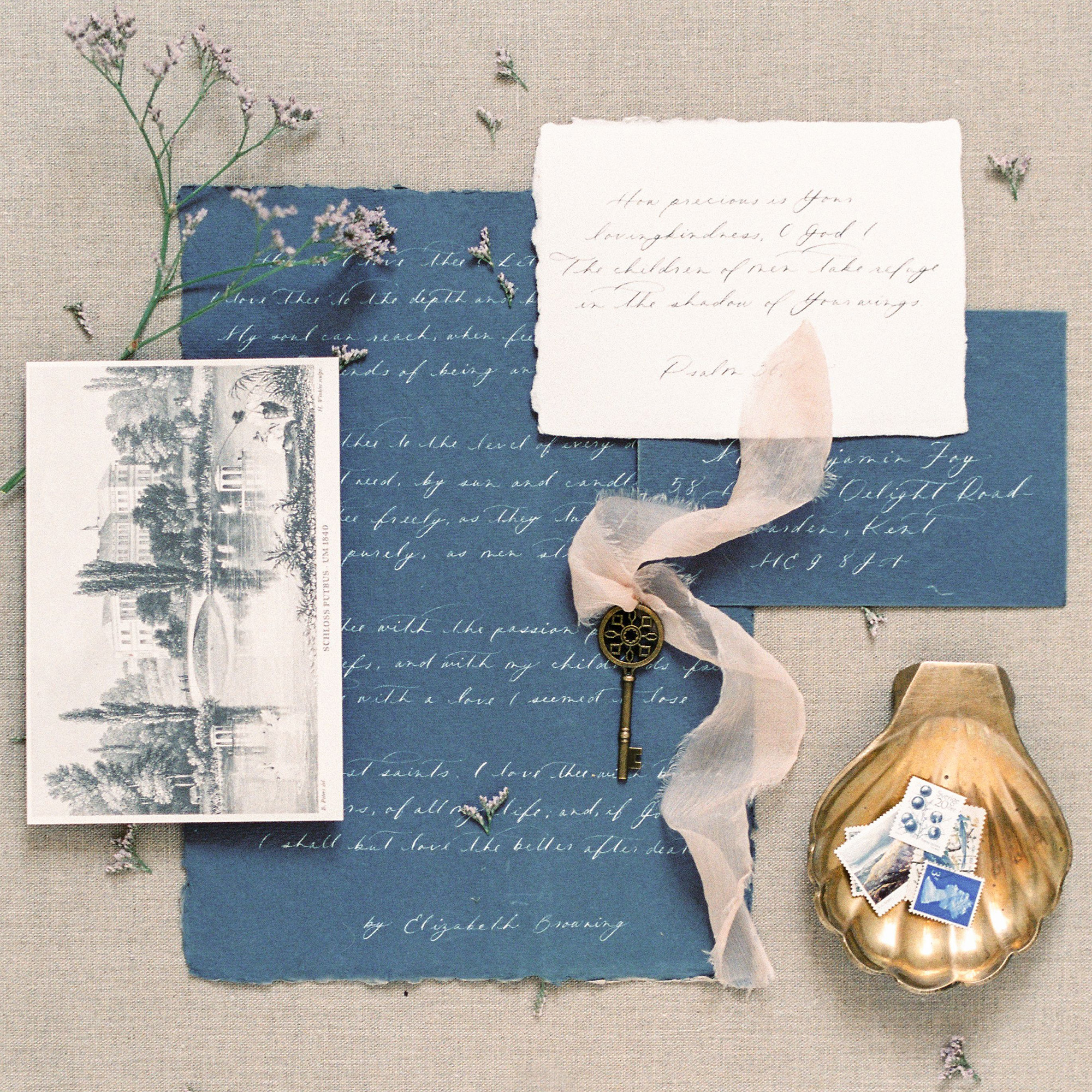
There is something undeniably beautiful about a sheet of paper that isn't perfectly perfect. A softly feathered edge. A slight variation from one side to another. The unmistakable feeling that the paper was made rather than manufactured.
Deckle edge paper has become a familiar sight in luxury wedding stationery, often paired with calligraphy, letterpress printing, wax seals, silk ribbon and handmade envelopes. Scroll through enough wedding inspiration and you might assume the deckle edge is simply another romantic stationery trend.
It isn't.
In fact, the deckle edge has a history that reaches back centuries. What we now intentionally choose for its beauty was once simply part of making paper.
What Is a Deckle Edge?
A true deckle edge is the soft, irregular edge created during the traditional papermaking process. Handmade paper is formed using a mould, essentially a framed screen that holds the paper fibers as water drains away. A removable frame called the deckle sits on top of the mould and determines the size and shape of the sheet.
As the pulp settles, fibers naturally collect and thin around the edges of the deckle. When the finished sheet is removed, those edges are slightly uneven and feathered.
No two are exactly alike.
Before modern papermaking machinery, this wasn't considered a special design treatment. It was simply how paper was made.
That distinction matters because today's fascination with deckle edges isn't really the invention of something new. It is the rediscovery of something very old.
From Ordinary Edge to Mark of Craftsmanship
Industrial papermaking changed our expectations of what paper should look like.
By the 19th century, machines could manufacture paper continuously rather than producing individual sheets by hand. Paper could be cut into perfectly consistent sizes with smooth, straight edges.
Suddenly, precision was possible.
And, as often happens in design, once perfection became commonplace, imperfection became interesting. The irregularities associated with handmade paper began to represent something different. They suggested craftsmanship, quality and a connection to traditional methods.
The deckle edge was no longer simply an unavoidable part of making paper. It became something worth preserving.
Why Are Deckle Edges Everywhere Again?
Wedding stationery has always had an interesting relationship with tradition.
We want invitations to feel timeless, but we also want them to feel personal. We appreciate beautiful old printing techniques, but we don't necessarily want an invitation that looks as though it came directly from 1890.
Deckle edge paper sits beautifully between those two worlds.
Its irregular edge softens a very formal invitation. It can make minimalist typography feel less severe and traditional typography feel less predictable. Even an extremely simple black and white invitation can become tactile and distinctive when printed on beautifully textured paper with a natural edge.
That versatility may explain why deckle edges have appeared in so many different styles of wedding stationery.
They can feel romantic.
They can feel organic.
They can feel old-world.
And, when handled carefully, they can feel remarkably modern.
But Not Every Rough Edge Is a True Deckle
This is where things get interesting.
The popularity of deckle edge stationery has created plenty of imitations.
A naturally formed deckle is created as part of making the sheet itself. Other papers can be torn, cut or mechanically treated afterward to reproduce a similar irregular appearance.
Visually, the difference can sometimes be subtle. Philosophically, it isn't.
A true deckle edge tells you something about how the paper was made. A simulated deckle tells you something about how someone wanted the paper to look.
Neither is automatically wrong. But if we're going to celebrate craftsmanship, it's worth knowing the difference.
And there is another consideration: more isn't necessarily better.
An exaggerated edge can quickly become the main event. Instead of supporting the typography and design, the paper begins competing with it.
Luxury stationery rarely needs to announce how luxurious it is.
The materials should simply feel right.
So, Trend or Tradition?
Both.
The current popularity of deckle edge wedding invitations is certainly a trend. Like vellum wraps, wax seals, silk ribbon, and oversized typography, we are seeing deckled paper used repeatedly in contemporary wedding imagery.
But the deckle edge itself isn't trendy.
It comes directly from one of the oldest traditions in papermaking.
Perhaps that's why it continues to work.
The most enduring stationery details often have a reason for existing beyond decoration. Engraving has depth because of the way the plate meets the paper. Letterpress leaves an impression because of the printing process. Handmade paper has variations because human hands and natural fibers don't produce absolute uniformity.
Those imperfections aren't flaws added afterward to make something look handcrafted.
They are evidence of the craft itself.
And that may be the most important distinction.
A deckle edge is at its most beautiful when it doesn't feel like an accessory added to an invitation because it's fashionable. It should feel integral to the paper, the typography, and the overall design.
Because good stationery has never been about adding every beautiful detail available.
It's about knowing which details belong.
Frequently Asked Questions
Old-world beauty. Modern-day ease.