
Knowing how to assemble wedding invitations correctly is one of those things that sounds simple, until you're staring at a beautiful pile of paper and wondering what goes where. You're not alone. Assembling a wedding invitation suite is one of those things that sounds simple until you're actually doing it, and suddenly you're Googling "does the tissue paper go on top or underneath?" at midnight.
Let's walk through everything you need to know: the correct order for tucking pieces into your envelope, whether you actually need an inside envelope, and how to address it properly if you choose to use one.
The Correct Order for Assembling Your Invitation Suite
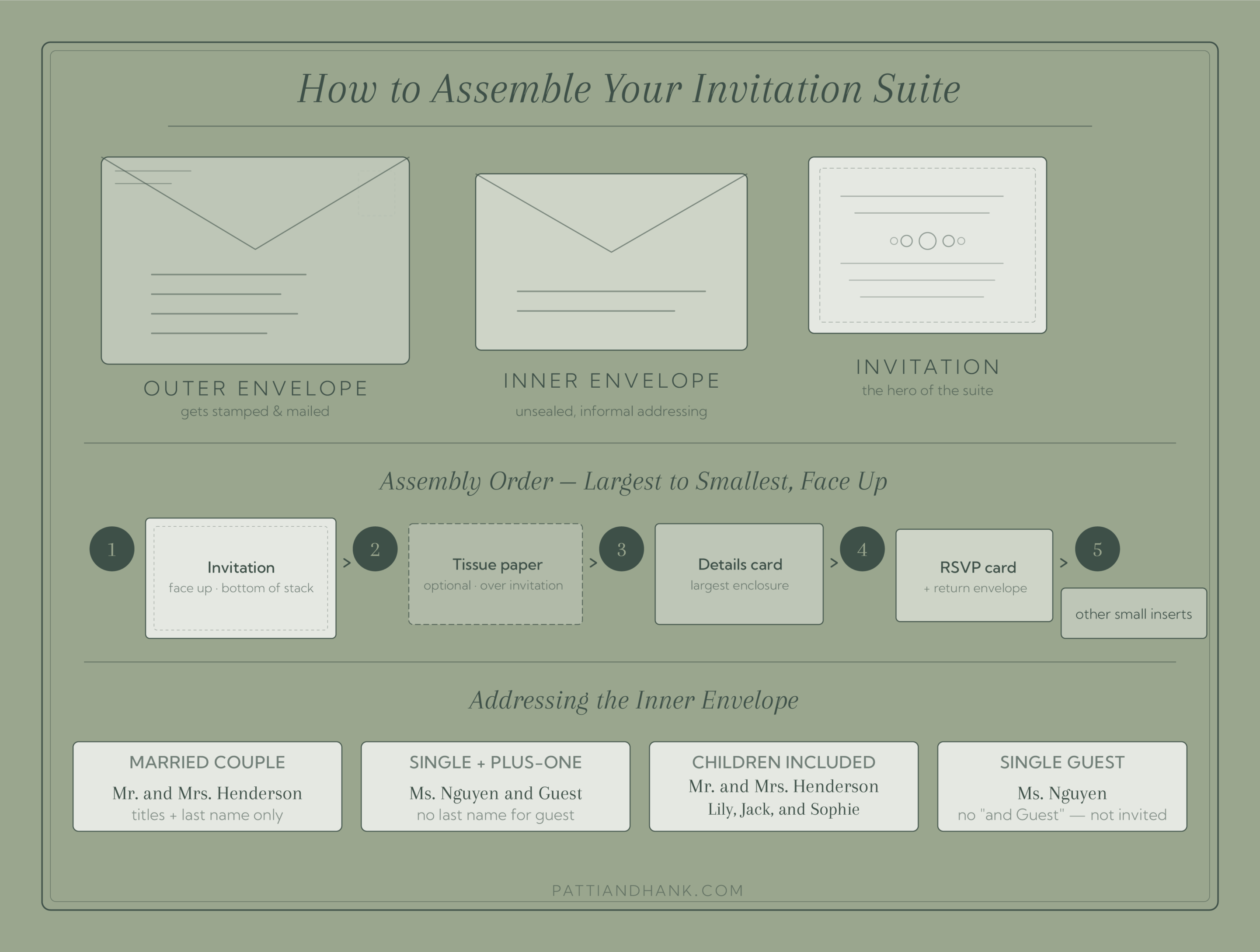
When you're ready to stuff your envelopes, the general rule is to layer your enclosures largest to smallest, face-up, with the invitation itself on top of everything. Here's how it typically works:
Start with your invitation as the foundation, it's the largest piece and goes on the bottom of the stack. Lay it face-up (printed side toward you).
Next come your enclosure cards, stacked on top of the invitation in order of size, largest first. This usually means your details card or accommodations card comes first, followed by your RSVP card, and then any other smaller cards (like a details insert, map card, or wedding website card).
Your RSVP envelope (if you're including a stamped, pre-addressed return envelope) goes behind the RSVP card, with its flap facing up.
Finally, if you're using tissue paper, a traditional finishing touch we'll talk about more in a moment, it lies directly over the front of the invitation, underneath the enclosure stack.
The whole assembled stack then slides into the inner envelope, followed by the outer mailing envelope. More on those in a moment.
Quick reference for the stack (bottom to top):
- Invitation (face up)
- Tissue paper (optional, over the invitation)
- Largest enclosure card (face up)
- Medium enclosure cards (face up)
- RSVP card (face up), with RSVP return envelope tucked behind it
- Smallest inserts
Do You Need an Inside Envelope?
The short answer: no, but there's a lovely reason they exist, and plenty of couples still choose to use them.
The inside envelope (also called the inner envelope) is an unsealed, unaddressed envelope that holds your actual invitation suite. It then slides into the outer envelope, which is the one that gets stamped and mailed.
A Brief History
The double-envelope tradition dates back to the 18th and 19th centuries, when mail was delivered by hand or on horseback. The journey was long, the roads were rough, and envelopes arrived crumpled, damp, and dirty. The outer envelope took all that abuse, so the inner envelope, and the pristine invitation inside, arrived clean and presentable.
There was also a social function at play. Before doorbell-ringing was common, a household servant or butler would receive the mail, remove the outer envelope (which was considered soiled from travel), and present the inner envelope on a tray to the household. The inner envelope was addressed informally to the actual guests, "Mr. and Mrs. Henderson," without a return address or formal mailing information, almost like a personal note of invitation.
That tradition carried forward into modern etiquette, where the double envelope became a mark of formality and care.
Do Couples Still Use Them Today?
Yes, especially for formal and traditional weddings. The inner envelope also serves a practical purpose: it lets you specify exactly who is invited, which is particularly helpful for managing plus-ones and whether children are included.
If your outer envelope is addressed to "The Henderson Family," your inner envelope might read "Mr. and Mrs. Henderson," a polite but clear signal that the children aren't invited to the wedding itself.
For more casual weddings, or when budget and simplicity are priorities, a single outer envelope is perfectly acceptable and widely used. Many modern couples skip the inner envelope entirely with no breach of etiquette.
How to Address the Inside Envelope
If you do use an inner envelope, the addressing is more relaxed and personal than the outer envelope. Here's how it works:
The inner envelope uses titles and last names only, no first names, no addresses, no return information. It's brief and direct.
- Married couple: Mr. and Mrs. Henderson
- Unmarried couple living together: Ms. Rivera and Mr. Kim (list the person you know better first, or alphabetically)
- A guest with a plus-one: Mr. Thompson and Guest
- Children included: Mr. and Mrs. Henderson / Lily, Jack, and Sophie (children's first names listed on the line below the parents)
- Children not included: Mr. and Mrs. Henderson only (no children listed)
- Single guest, no plus-one: Ms. Nguyen (name only — no "and Guest")
The inner envelope is also where you can get a little warmer if you'd like. Some couples choose to use first names on the inner envelope, especially for close family or friends: "Aunt Claire and Uncle David" or simply "Sarah and Mike." That's completely appropriate and adds a lovely personal touch.
A few things to keep in mind:
Write out full title, Mr., Mrs., Ms., Dr., rather than abbreviating or going too casual. If someone holds a professional title like Doctor or Judge, use it. If a couple has different last names, write both names out: "Ms. Carter and Mr. Ellis."
If you're unsure about a guest's title or name spelling, take the extra five minutes to find out. It genuinely matters; an invitation is often the first tangible thing guests hold from your wedding, and it sets the tone.
One Last Note on Tissue Paper
Tissue paper inserts are another old tradition rooted in practicality: when engraved invitations were the standard, the tissue helped prevent the ink from smudging during transit. Today's printed invitations don't have the same smudging problem, but tissue paper remains a beautiful, delicate touch that feels wonderfully old-world. If you love the look of it, use it. If you'd rather simplify, it's entirely optional.
Putting together your invitation suite is one of those small wedding tasks that ends up feeling more meaningful than you expect. You're literally packaging the first impression of your celebration and sending it out into the world. Taking the time to do it thoughtfully, the right order, the right envelopes, the right names, is a small act of care that your guests will notice, even if they can't quite put their finger on why it feels so special.
Download this handy reference guide and keep it on hand for assembly day.
Frequently Asked Questions
Ready to fill those envelopes? The Heritage Collection features 12 beautifully coordinated wedding suites, from Tuscan and Coastal to English Garden and Noir, all editable in Canva so every detail is exactly yours.